
In August, our team talked to a dealmaker at a North American middle-market firm about the firm’s NDA volume for the year. It was running behind 2025, “especially this summer, it has been very light,” they told us. But they added, “I’m not too fussed about it. We’re closing a lot of deals.”
Both halves were true, and together they describe the third quarter: closings grew while the pipeline feeding the fourth quarter thinned.
Closings grew, and the pipeline paused
NDAs are signed at the very start of a transaction, which makes them a powerful leading indicator.
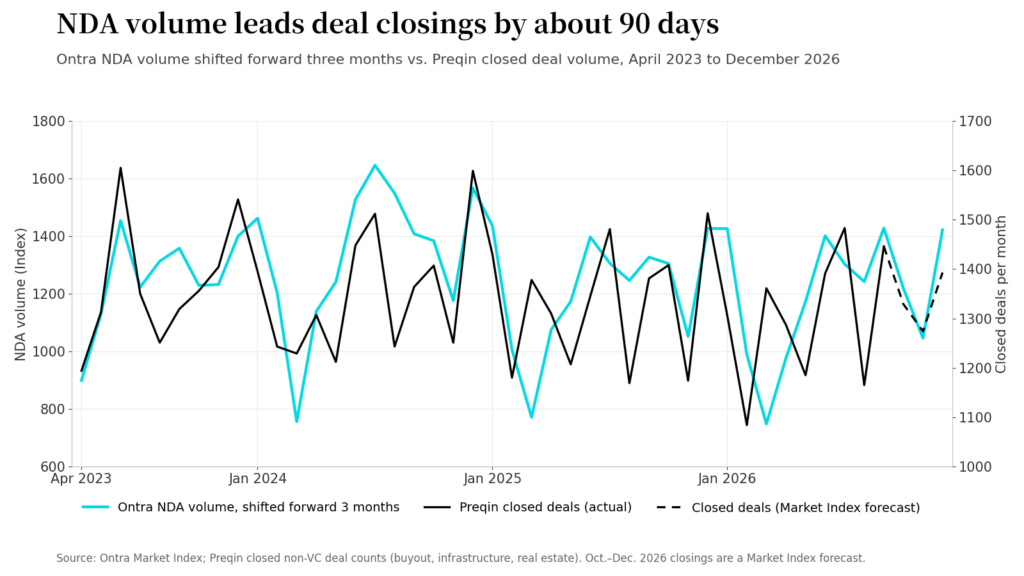
Our mid-year report called for Q3 closings to grow year over year, and they did. Preqin’s closed deal volume rose 1.5%, short of the 3.2% we forecast, but it was the first meaningful growth after four straight quarterly declines. Q2, which we reported as up 3.2% at mid-year, came in flat after Preqin’s data was refreshed.
The signal for Q4 is cooler. Q3 NDA volume fell 2.6% year over year, dragged down by a weak July. August and September held close to prior-year levels, so this reads as a pause, not a collapse.
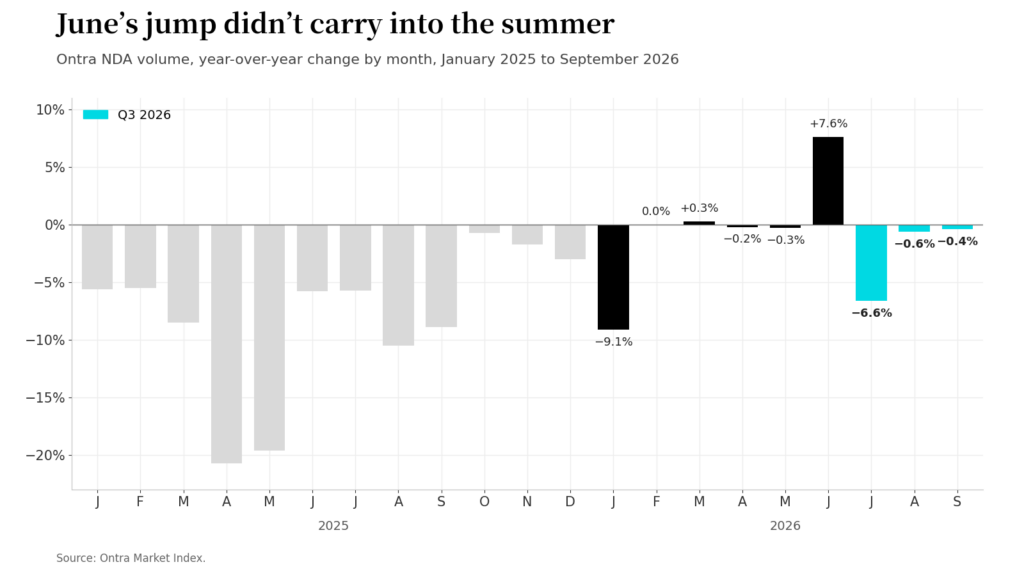
The pause was concentrated in the US. Outside it, NDA volume grew by 6.6% in Q3, with no negative months.

Smaller firms (the bottom 80% of the Market Index by NDA volume) led the spring recovery, then finished Q3 down 2.9%. The firms with the least cushion were the first back to the table in the spring and the first to step back this summer.
Why intent is slow to become closings
The easy read is that dealmakers lost their nerve in July. Our conversations with dealmakers this summer point to three reasons intent was slow to turn into closings:
The first is a crowded field. Firms that deployed little capital over the past few years are now chasing the same assets. It “finally feels like we’re starting to see more deals come to market,” an investment professional told us in July. “The issue that we’re also seeing is that processes are being very competitive.”
Every bidder in a process signs an NDA. Only one of them closes. More bidders per deal means more intent shows up in the NDA data than will ever show up in closings.
The second is the cost of money. In September, the Federal Reserve raised its benchmark rate to 3.75%–4.00%, citing elevated inflation. The 10-year Treasury yield is up more than 100 basis points since the end of 2025, and yields on middle-market unitranche loans rose roughly 35 basis points in Q3 alone. Competitive processes push prices up, while higher rates raise the cost of financing them.
“Rates are crazy high, which just increases the bar to get any deal done,” said Jon Song, VP, GTM Operations and Strategy at Ontra. “Coupled with more competitive processes, it’s hard to make the returns work.”
The third is time. “Processes are taking a lot more time, a lot more effort,” an executive at an EMEA private equity firm told us in August. A longer path from NDA to close pushes closings out even when early-stage activity holds up.
Outside data points the same way. PwC’s 2026 mid-year M&A outlook found that transactions above $5B made up almost half of global deal value through May, double their share two years earlier. Larger deals typically carry longer diligence and approval timelines
Q4 takes a step back
Applying our regression model to NDA volume, we project 3,996 closed deals in Q4 2026, 2.4% below Q4 2025.
This breaks down to:
- 1,329 in October
- 1,274 in November
- 1,393 in December
That would reverse Q3’s 1.5% gain and put closings back into year-over-year decline.
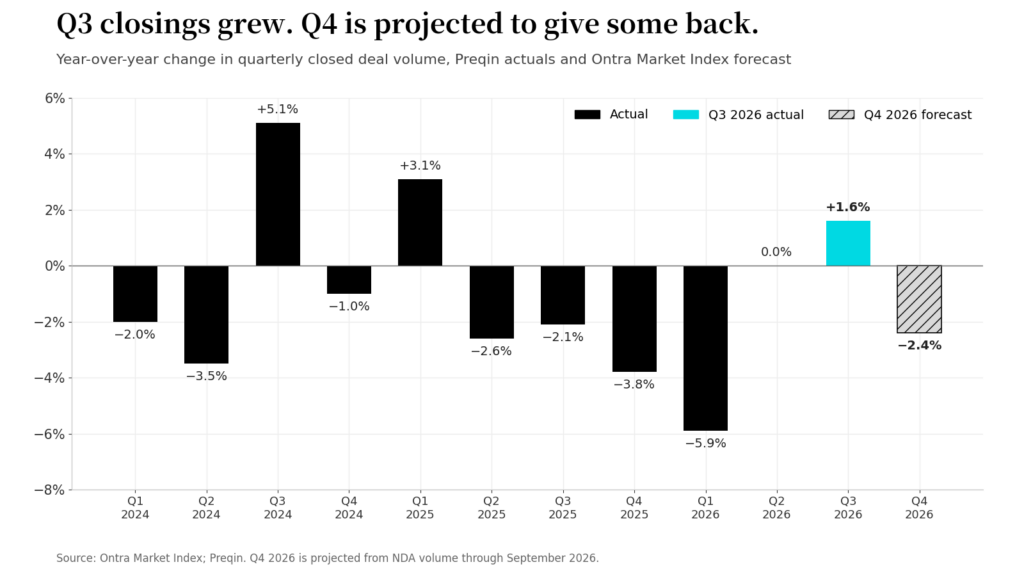
If that holds, 2026 will finish nearly 2% below 2025, the third straight annual decline.
Because the forecast compares Q4 with Q4, the usual year-end slowdown is already baked in. Expect NDA volume to dip below Q3, as it has in each of the past three years. Anyone who has chased a counterparty’s signature the week before a holiday knows why.
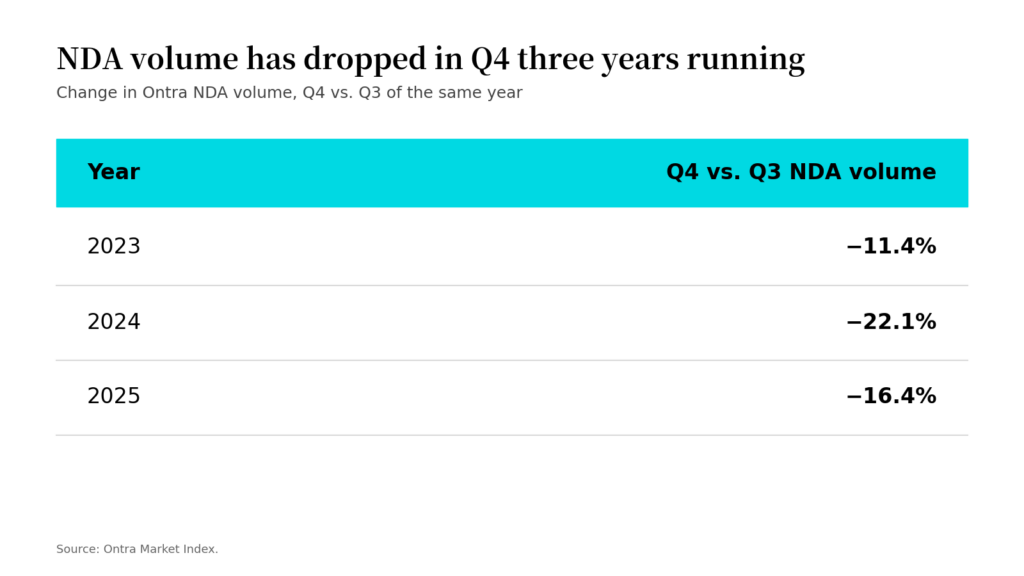
Dealmakers are already planning for it. “I’d expect September to turn out good, probably October pretty good, and then maybe November, December wind down a little bit,” an investment professional at a North American healthcare-focused firm told us in September.
October will be the month to watch, because October NDAs are the first read on Q1 2027 closings. If volume returns to growth, July was a blip, but if it slips again, the pause runs into the new year.
Keep NDAs off the critical path
A market with more bidders per deal and longer processes produces more NDAs per closing, not fewer. That work lands on the legal teams, whether or not the deal closes, and it competes for attention just as firms push to wrap things up by year-end
AI-native services enable firms to absorb that volume without adding headcount or increasing outside counsel spend. Ontra’s Contract Automation combines purpose-built, industry-specific AI capabilities with an experienced global network of legal professionals to handle routine agreements like NDAs, joinders, and non-reliance letters.
- Accelerate routine contract negotiations: Incorporate AI-enabled data insights and workflow tools to negotiate from a position of strength and move contracts forward faster.
- Drive quality and consistency across agreements: Leverage digital playbooks and historical contract information to enhance negotiation outcomes and ensure the same approach to negotiations every time.
- Reduce costs: Finalize agreements with fewer internal resources, less external spending, and predictable per-contract fees.
Every bidder signs an NDA, but only one closes. A bottleneck should never be the reason your firm isn’t that one.
Ontra is not a law firm and does not provide any legal services, legal advice, or referral services. The contents of this article are for informational purposes only, and are not intended to constitute or be relied upon as legal, tax, accounting, regulatory, or other professional advice.
The organizations referenced in this article have no affiliation with Ontra, and neither Ontra nor such organizations promote or endorse the other’s products or services.