Back in 2021, EY Law and Harvard Law School’s Center on the Legal Profession found that 87% of legal departments reported spending too much time on low-value, routine tasks. This was years before AI entered the zeitgeist, but even now, with AI tools proliferating across every industry, the shape of the problem remains intact. 92% of lawyers use at least one AI tool daily, 74% use AI weekly, and 36% of legal departments are actively deploying GenAI, yet many private markets legal teams are still seeking meaningful relief from the low-value, routine tasks that AI was supposed to take on.
For a private markets legal team, that unrelieved work often takes the form of NDAs. One head of legal at a European private markets firm told us his team sees roughly 50 NDAs a week and described them as a distraction from the work that requires real mental input. Another lawyer at a large global asset manager described it even more bluntly; historically, the lawyers handled NDAs, “but it just became overwhelming.” Yet even with the majority of legal teams using general-purpose AI tools, Bloomberg Law found that AI outputs “still require significant oversight, which often offsets the efficiency gains they promise,” with one-third of in-house professionals who use AI at least a few times a month saying it saves them less than 30 minutes a day
Set that against the deal side. In KPMG’s 2026 Global M&A Outlook survey of 700 senior dealmakers, 59% said AI was delivering substantial efficiency gains in competitive intelligence and market analysis. And McKinsey’s Global Private Markets Report 2026 said that “some GPs report productivity gains of 30 to 40 percent in analyst-intensive tasks” even if adoption remains uneven.
Why is there such a stark difference between the deal team and the legal team?
The difference between the two teams
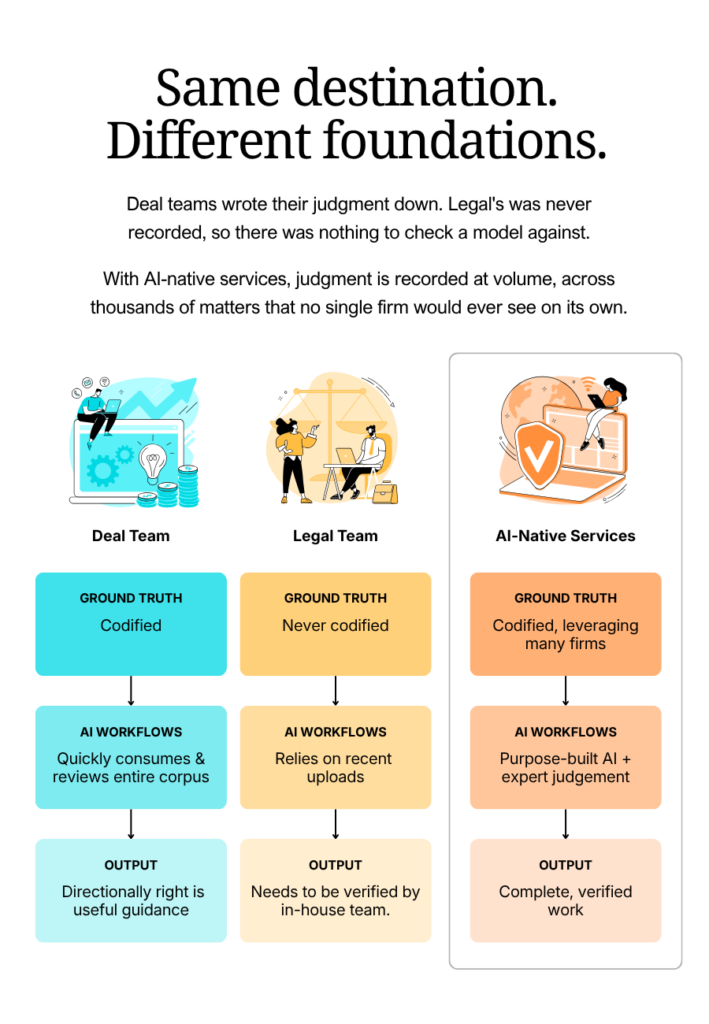
Screening targets and reading data rooms are forgiving work: a good-enough AI-driven first-pass review of a large pile of documents is incredibly useful, and a knowledgeable analyst can catch what may have been missed. That’s because deal teams tend to have something legal doesn’t; their judgment is usually written down—investment committee memos, underwriting notes, valuation models, and the record of which deals they passed on and why. Point any AI tool at that corpus, and there is both something to learn from and something to check against.
As Eric Hawkins, Ontra’s CTO, puts it: “In AI engineering, the record of what a correct answer looks like—built from expert humans making the same call over and over—has a name: ground truth. It’s the only way you check whether an AI system got something right at scale, instead of eyeballing every answer yourself.”
Legal’s version of that ground truth was never written down. Precedent lives in individual inboxes and in the heads of people who have negotiated these agreements for decades. “Legal and compliance teams were asked to skip straight to AI-driven automation,” Hawkins writes, “with no ground truth to validate the outputs.”
Deterministic vs. probabilistic
Deal analysis relies on synthesis, and it can easily leverage a model that turns a lot of information into something directionally useful. Legal and compliance work is binary. There is no roughly correct answer to whether you’re permitted to do something, or whether a required notice went out. “A plausible-sounding wrong answer is worse than no answer at all,” Hawkins writes, “and without ground truth to check it against, you’re pointing a probabilistic tool at a problem that only accepts one right answer.”
96% of professionals say their AI must safeguard confidential data, 94% require verified authoritative content, and 90% need outputs they can explain and defend, yet among in-house teams, 59% say they lack AI tools that clear that bar. The break from pre-AI software, notes Jeff Okita, VP of Product at Ontra, is that the old version was deterministic: “one input, one output, and that’s just no longer the case anymore. When you’re running skills over and over again, you’re going to get a lot of variance.”
Then the two functions collide. An AI-powered deal team can look at more opportunities, which means more counterparties. More counterparties mean more NDAs are being routed to a legal team that hasn’t seen the same efficiency gains from AI as its peers.
The gap doesn’t close by working later
Building a record of legal judgment isn’t something a single firm can easily justify against its own NDA volume. But without that record, the data doesn’t persist: the tool produces an answer, forgets it, and answers the next question from whatever happens to be nearby, whether that’s scattered files, a handful of recent outputs, or the wrong source entirely. That is also why the verification burden never lifts. 89% of senior legal professionals say AI-generated legal work should be checked by a human before use, and 48% say humans always or often materially change the output before it can be used. With nothing to check the model against, the checking falls to a person at every step, which means the person who was supposed to be relieved remains trapped as the reviewer.
At the same time, a general-purpose AI tool produces an answer and then forgets it. The judgment is not captured, and it does not reach whoever has to act on it. At one private equity firm, the DDQ process is to “take the last three to five DDQs that we’ve completed, start a project in Claude,” and the team would go from there. Every cycle begins from the last few outputs rather than a verifiable record.
How AI-native services solve the problem
AI-native services invert that arrangement. AI tools can make a legal team faster, but the work—and the accountability for it—stays in-house, competing with everything else on the docket. Traditional outsourcing moves the work out, but it returns billed by the hour, with little cost visibility when volume spikes. An AI-native service does both: purpose-built AI handles the repeatable execution, experienced legal professionals supply the judgment, and the provider carries accountability for whether the finished work is right. The price is tied to the deliverable rather than the hours spent on it, so as volume grows, you can calculate the cost instead of bracing for it.
As the leader in AI-powered solutions for the private markets, Ontra’s Contract Automation takes the negotiation end-to-end—from intake through execution—with only exceptions being escalated. In 2025, Ontra’s legal network negotiated over 1,000 NDAs every business day, in addition to other contracts, including joinders, engagement letters, and non-reliance letters. That is the raw material ground truth is made from: expert judgment, recorded at volume, across thousands of matters that no single firm would ever see on its own.