
In our most recent Market Index Report, our team analyzed over 645,000 negotiated NDAs. While most of the terms didn’t move, two took a noticeable dip from the 2025 baseline, but the last—AI-related clauses—surged 9.4x between Q1 2025 and Q2 2026.
| Term | Share (Q2 2026) | 2025 baseline | Change |
|---|---|---|---|
| Permitted disclosure to LPs / co-investors / financing sources | 69.10% | 69.47% | 1.0x |
| Deal-existence confidentiality | 59.51% | 58.89% | 1.0x |
| Data room | 43.66% | 41.29% | 1.1x |
| No representation as to accuracy | 33.92% | 33.32% | 1.0x |
| Securities law / MNPI acknowledgment | 19.69% | 20.73% | 0.9x |
| No-contact / non-circumvention | 16.33% | 13.51% | 1.2x |
| Club deal / consortium restriction | 13.21% | 12.96% | 1.0x |
| AI-use restriction | 6.12% | 0.65% | 9.4x |
| No obligation to proceed (non-binding) | 6.02% | 5.58% | 1.1x |
| Standstill | 2.39% | 2.51% | 1.0x |
To be specific, AI-use restrictions grew from 0.65% of NDAs in Q1 2025 to 6.12% in Q2 2026. The most recent quarter was the steepest of the six, and the share grew somewhere between 6 and 16 times inside every document type we track, from short, standard NDAs to the longest premier ones.
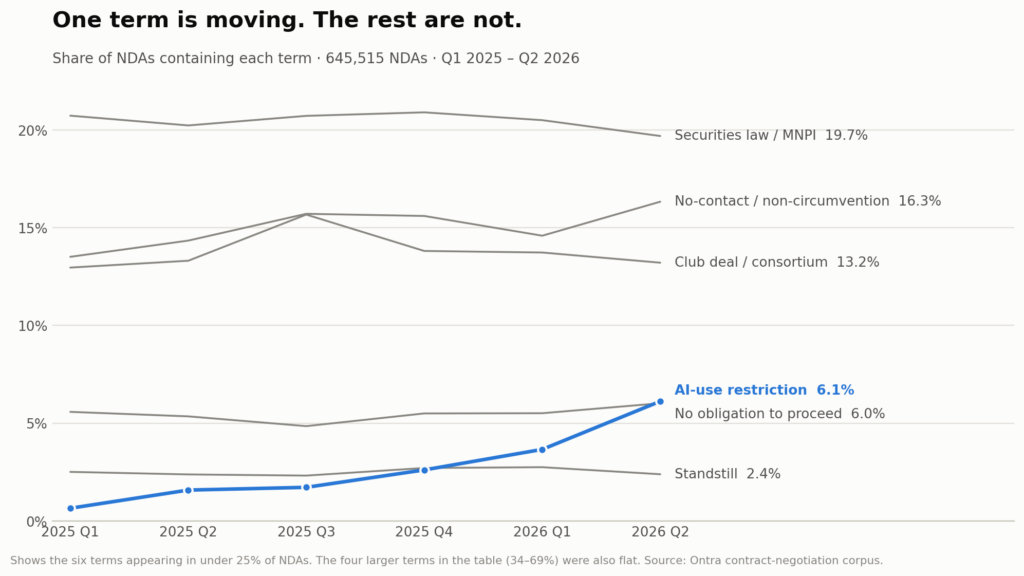
AI-use restrictions are rising, but appear in only 6% of NDAs.
A 9.4x increase over six quarters is the fastest rate of change anywhere in our report, but six percent is still small enough that most legal teams have likely encountered the clause without yet registering it as a pattern.
NDAs need to catch up to the proliferation of AI
Individuals have adopted generative AI faster than their firms developed policies around it: 86% of corporate and private equity leaders say they have integrated GenAI into their M&A workflows, with 65% doing so within a single year. Yet only 9% are confident they could pass an independent AI governance audit within 90 days.
One principal at a US-based private equity firm told us that less than 10% of the NDAs that they see have an AI-related clause in them, “but the ones that do, it’s pretty robust…We’re trying to grapple with the fact that the data we’re inputting into the LLM is not being allowed for external use.” And while enterprise agreements are meant to settle that question, they only govern the accounts a firm controls. In a survey of 1,000 employees at large companies, 57% said they had entered confidential information into a public AI assistant, mostly through personal rather than company accounts.
A disclosing party asking a firm to keep its materials out of an LLM is not being paranoid.
As Eric Ostroff, managing partner at Meland Budwick, P.A., and chair of the firm’s trade secrets and IP group, wrote in Bloomberg Law: “AI is a channel that didn’t exist when most NDAs currently in force were drafted. The language needs to catch up.”
How does this affect GCs?
Currently, GCs are far more likely to see an AI-restrictive clause than to write one as 82% of these restrictions arrive in the counterparty’s first draft. GCs can’t control whether the ask appears, only whether they have an answer when it does, and the ask is increasing. 77% of firms in our data have received at least one AI-use restriction, up from 9% in January 2025, even though the clause still shows up in only 6% of individual NDAs.
Yet as of June 2026, across roughly 1.9 million codified playbook positions, not one records a stance on AI use. Every uncodified clause is a judgement decision made from scratch, which can add roughly three extra business days to the negotiating timeline. At 6% that’s absorbable, but if the trend continues, codifying now means that GCs make the call once, deliberately, instead of repeatedly under deadline.