DDQ volume is growing, teams are buried under requests, and generic AI is creating false confidence. Neither generic LLMs nor horizontal RFP tools were built for private fund workflows. They break down at crucial steps. Instead of running that risk, firms can automate DDQs with purpose-built AI by digitizing and centralizing approved precedent in a single repository, letting AI take the first pass at answers, and providing a reliable way to retrieve the most recent, accurate, and approved answers. Take a look at what effective DDQ automation looks like with a purpose-built AI solution.
The best DDQ workflow: compare your options
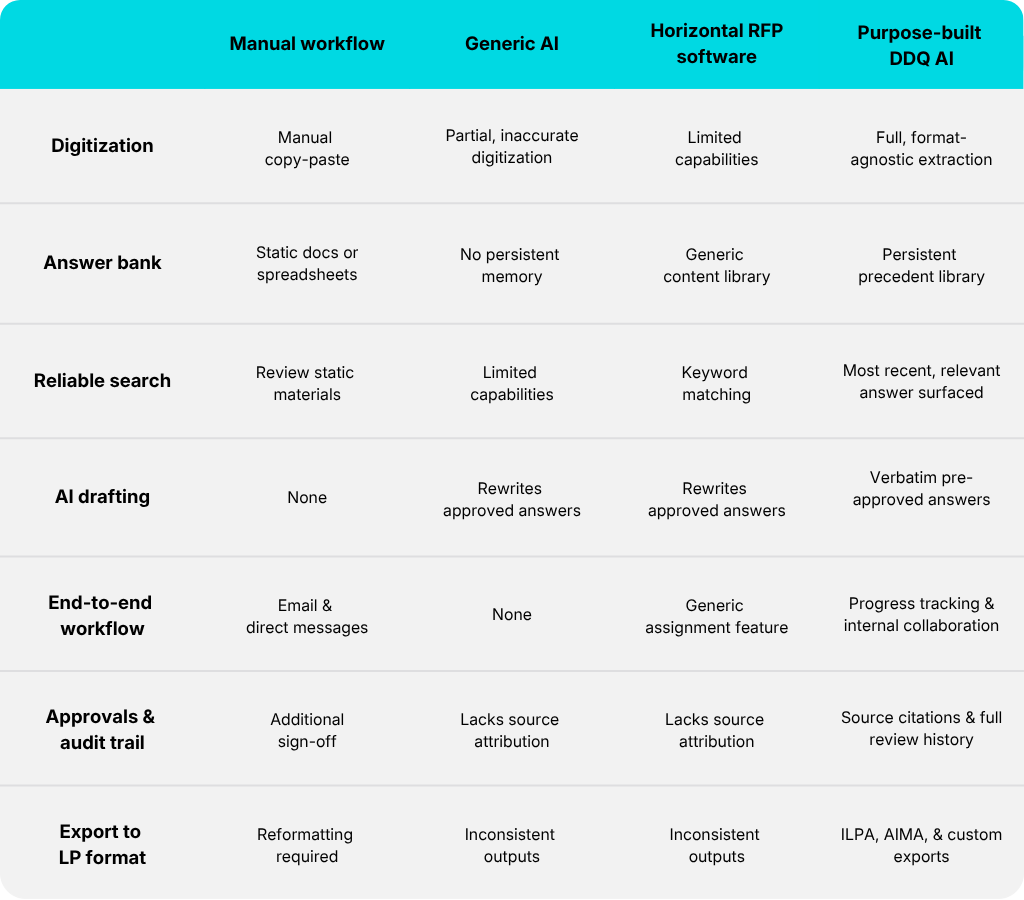
Each option produces meaningfully different outcomes at every step of the DDQ process. The table below summarizes how they compare across the core capabilities private funds require.
Where generic AI breaks down for DDQs
We’re seeing PE firms experiment with frontier LLMs more and more. In working with our co-development partners and customers, we’ve found that a common disadvantage of relying on generic AI solutions is a lack of persistent memory and institutional knowledge. LLMs cannot establish or maintain a repository of precedent and approved answers to serve as a single source of truth for IR and other internal teams.
This issue becomes apparent in what we’ve dubbed the “upload and prompt illusion.” PE professionals upload one or a few documents in an LLM chat, craft a prompt, get a seemingly accurate output, and label the experiment a success. But with the next DDQ, they have to start over, and none of these chats benefit their colleagues.
There are too many structural limitations for LLMs to act as a single source of truth for PE firms, such as:
- Data limitations: There’s a limit on how much data you can upload in a single session.
- Context windows: LLMs have a limited “working memory,” which includes your prompt, previous conversation history, and system instructions. The model’s recall degrades with repeated tasks and questions.
Additionally, there’s no easy way to connect an LLM to the firm’s institutional knowledge, such as how obligations are categorized, which precedent documents should guide future negotiations, or how to format investor reports. This information is scattered across people and documents, and attempting to embed it into the LLM is a drastic increase in someone’s workload.
Inevitably, firms fail to achieve ROI from using generic LLMs for DDQs and seek out a better option, kick-starting a new diligence and implementation process.
What real DDQ automation with AI looks like
Real DDQ automation isn’t a single feature — it’s a connected workflow that eliminates manual effort at every stage. Here’s what each step looks like with purpose-built AI, and where manual processes, generic AI, and RFP tools fall short.
Step 1: Digitize the request
Every DDQ arrives in a different format — Excel, Word, PDF, or LP portal. Purpose-built DDQ software extracts every question from any of these into a structured digital list, ready for assignment.
Compare your other options:
- Manual: Copy-paste into a master tracker by hand. Slow, error-prone.
- Generic AI: Extracts text but loses structure, mishandles sub-questions, and doesn’t carry into a workflow.
- RFP software: Built for predictable sales templates, not the format variability of LP and operational due diligence requests.
Step 2: Build a single source of truth
A precedent library is the foundation of effective automation. Ontra’s purpose-built system ingests completed questionnaires, policy documents, PPMs, and ILPA templates, then creates a persistent answer bank scored by recency, source, and approval status.
Compare your other options:
- Manual: Answers live in old DDQs and senior staff memories, widening knowledge gaps between veteran and junior team members.
- Generic AI: LLMs lack persistent memory, relying on your DMS or uploaded docs. Nothing is structured into a permanent answer bank. The firm doesn’t build institutional knowledge along the way.
- RFP software: Stores content libraries but doesn’t distinguish fundraising, operational, and ESG questionnaires or fund strategies.
Step 3: Reliably retrieve answers
Internal teams often need to search precedent materials to answer questions or verify generated responses. Ontra’s DDQ solution offers comprehensive search across the firm’s entire precedent library, ranking results by relevance and recency to provide the strongest possible answer to each question.
Compare your other options:
- Manual: Teams search through precedent documents, email threads, and spreadsheets looking for the most recent, approved answer.
- Generic AI: LLM context windows limit search capabilities over time. Connecting an LLM to a large dataset, such as DMS, may not return a complete or current answer.
- RFP software: Routing logic wasn’t designed for the legal review patterns of private fund disclosures.
Step 4: Let AI handle the first draft
This is where automation pays off or breaks down. Purpose-built AI recognizes similar questions, surfaces the strongest approved responses, and drafts new answers anchored to LP, strategy, and question context when no precedent exists. Ontra’s DDQ solution specifically cites the source and context of a generated answer, enabling swift verification.
Compare your other options:
- Manual: Scroll through prior DDQs, trying to remember which answer applied to which question.
- Generic AI: LLMs may rewrite compliance-approved language or exaggerate, overriding the version the legal team reviewed and approved. Generated answers lack source citation, hindering verification.
- RFP software: Matches on keywords but struggles when LPs ask the same question 10 different ways.
Step 5: Approve, finalize, and export
Once answers are reviewed, the system has to produce a clean export in the LP’s original format — ILPA, AIMA, custom Excel, or a portal upload — without losing approved language or fidelity.
Compare your other options:
- Manual: Copying and pasting from the master tracker into the LP’s format poses a high risk of human error.
- Generic AI: Doesn’t produce LP-formatted output.
- RFP software: Supports exports but often loses fidelity on industry-standard templates.
Building trust in AI: the human-in-the-loop principle
AI will never replace an experienced professional’s judgment, whether it’s a PE firm’s GC or a 20-year IR veteran. DDQs require review and experience to ensure LPs receive the most accurate and complete responses.
DDQ AI supports experts by taking the first pass and streamlining the workflow from one step to the next, while always keeping humans in the loop. With Ontra’s DDQ solution, every AI-generated response is cross-referenced against the firm’s approved precedent with a clear citation to the source document, so reviewers see what the AI suggested, where it came from, and whether it’s been approved before.
Conclusion: the case for purpose-built DDQ automation
DDQ volume isn’t going down — ILPA DDQ 2.0 expanded the standard template, LPs are layering on supplemental questions, and operational and ESG reporting cycles continue alongside active fundraises. Firms that respond quickly with consistent, approved, audit-ready language earn more LP confidence and free their teams to focus on the strategic investor conversations that actually move capital.
The AI shortcut is real, but only if the AI solution understands private markets. Manual workflows can’t scale. Generic AI can’t be trusted with regulated and nuanced content. Horizontal RFP tools can’t model how GPs and LPs actually interact.
Purpose-built DDQ automation can do it all. Ready to explore DDQ automation for the private markets? Schedule an Ontra DDQ demo today.