Inbound Know Your Customer (KYC) requests are deceptively challenging. They look routine — until you’re staring at a 60-question counterparty questionnaire, three entity charts, a deadline that moved up overnight, and a request for sensitive information that’s outside scope.
For private equity firms, inbound KYC services (also called reverse KYC) sit at the intersection of regulatory compliance, risk management, and deal execution. And because these requests are prerequisites for mission-critical work — opening accounts, securing credit facilities, onboarding vendors, and closing transactions — slow or inconsistent responses create real business drag.
Accelerate your responses and clearance with fully outsourced KYC services from Ontra. By entrusting our experienced and dedicated KYC analysts, you can overcome the challenges of inconsistent KYC volume.
Options for managing inbound KYC requests
There are several ways to manage inbound KYC, depending on your firm’s volume, complexity, and bandwidth.
- In-house processes: Firms may rely on their internal legal, compliance, and legal ops teams to manage KYC requests.
- Technology-only tooling: Firms may use off-the-shelf software primarily for document storage and organization.
- Fully managed services: Firms may outsource KYC requests to a dedicated team that takes ownership of the workflow, escalates only when necessary, and drives the request through clearance.
When firms manage inbound KYC in-house, they often experience the same predictable failures:
- Inconsistent submissions that trigger follow-up loops,
- Back-and-forth required to prevent oversharing of sensitive information, and
- Delays that stall funding or closings.
In-house tech solutions don’t solve the full problem, either. They typically provide basic document organization, while leaving teams to coordinate requests, execute documents, and respond to counterparties.
The only solution to the challenges with inbound KYC requests is an end-to-end outsourcing approach.
What are inbound KYC services?
Inbound KYC refers to the process of organizations providing their business and financial information to a third party to fulfill that party’s KYC requirements. In the inbound KYC context for private equity firms, KYC services typically include:
1) Document collection and organization
- Questionnaires and counterparty forms
- Structure charts and organizational diagrams
- Formation documents, certificates, and authorizations
- AML letters, certifications, and policy documents
- Precedent materials from prior submissions
2) Request coordination and communications
- Intake, tracking, and deadline management
- Clarifying ambiguous or duplicative requests
- Coordinating with internal stakeholders and external counterparties
- Managing follow-ups through clearance
3) Quality control
- Completeness checks (every question answered, every attachment included)
- Consistency checks (answers align with precedent and current facts)
- Version control (the “right” structure chart is the current one)
The end-to-end KYC process for inbound requests
A reliable inbound KYC operation isn’t “answering questionnaires.” It’s managing a repeatable workflow from intake through clearance, with the right controls at each step.
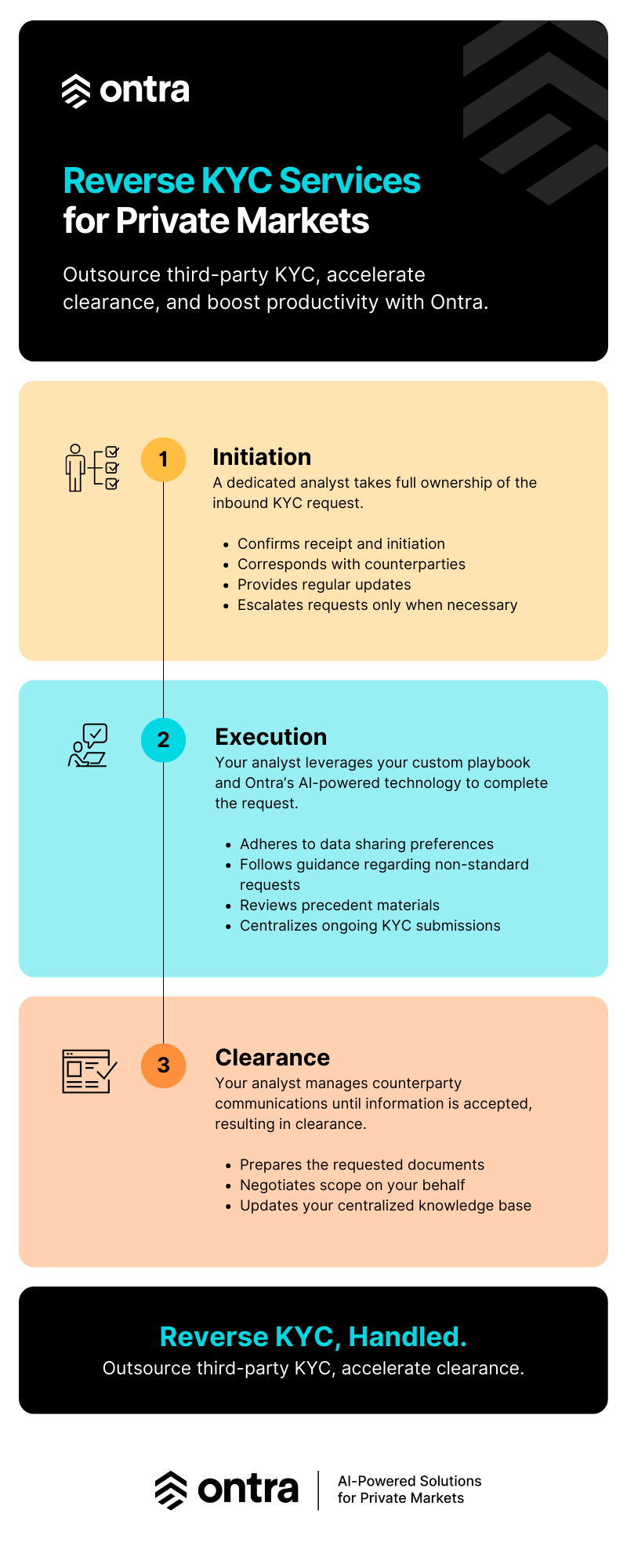
Ontra’s end-to-end KYC service standardizes the intake process, making every request actionable within minutes. Your dedicated KYC analyst captures essential information immediately:
- Counterparty name and request purpose
- Deadline and escalation path
- Entities in scope
- Required documents
Execution is where most internal teams lose time — because “find the latest structure chart” becomes an internal scavenger hunt. Ontra helps your firm build a repeatable approach to commonly requested documents, such as structure charts, standard certifications and policy excerpts, and pre-approved AML representation letters.
During this time, your analyst will flag non-standard asks, sensitive information requests, and incomplete instructions. They will manage counterparty communications, negotiate scope on your behalf, and address challenges in accordance with your predetermined playbook and precedent materials.
To promote consistency, your analyst will:
- Use precedent answers and validate against current facts.
- Confirm that entity names, ownership references, and organizational details match structure charts.
- Apply internal standards for phrasing, definitions, and “not applicable” responses.
- Validate attachments and references.
Finally, your analyst will treat submission as a tracked milestone, not a “send and hope.” They’ll maintain an audit trail of what was submitted, when, and to whom. They’ll also ensure your centralized knowledge base is updated with the latest information and precedent materials to support the next inbound KYC request.
Benefits of end-to-end inbound KYC services
Inbound KYC can be managed reactively. Or it can be managed as an operating capability. The difference shows up in speed, risk, and team capacity.
Speed to clearance
Faster turnaround supports deal velocity and financing timelines. It also reduces the operational drag that slows execution when every request becomes a fire drill.
Scalability
KYC volumes fluctuate. A resilient approach flexes without reorganizing the team every quarter.
Team capacity
Inbound KYC is repetitive by nature. Without support, legal ops, legal, and compliance leaders lose hours to coordination, document chasing, and formatting — not skilled, strategic work.
Consistency
Playbooks and precedent materials reduce variability — the enemy of predictable clearance.
Cost control
A defined operating model produces predictable costs. Ad hoc escalation to outside counsel and internal context switching does not.
How to choose a KYC service provider
You’re not just selecting a vendor. You’re selecting a partner for a sensitive, time-bound compliance process. When evaluating potential KYC services, ask the tough questions.
- What does your managed service cover?
- How do you handle non-standard requests and scope negotiations?
- What is your escalation threshold, and what triggers legal review?
- How do you maintain consistency across submissions over time?
- What do peak-volume support and deadline coverage look like in practice?
Red flags to watch for
- Repository-only tools that don’t take workflow ownership
- No standardized playbooks for declining or narrowing out-of-scope asks
- Unclear quality control, accountability, or timelines
- A model that requires heavy involvement from your internal team for routine tasks
What makes KYC services trustworthy and reliable?
Domain expertise in private markets workflows
Familiar with fund manager structures, financing timelines, and vendor onboarding realities
Understands the nuance of counterparty requests and documentation expectations
Quality control
- Clear ownership of each request
- Documented review steps and escalation rules
- Consistent validation before submission
Turnaround-time expectations
- Defined service levels and response timelines
- A plan for peak periods
Playbook-driven standardization
- Written guidance for what to share, what not to share, and when to escalate
- Standard responses for common patterns and recurring questions
A single source of truth for KYC data
- Centralized precedent submissions and core documents
- Version control so teams don’t drift across submissions
Security and confidentiality standards
- Encryption and access controls
- Disciplined handling aligned to regulatory compliance expectations
- Clear rules for sensitive information and data minimization
Transparent, predictable pricing
- Per-request or volume-based pricing that legal and compliance can forecast
- Clear boundaries on what’s included
Auditability
- Traceable history: what was submitted, when, and to whom
- Easy retrieval for exams, audits, and internal reviews
Low-friction engagement model
- Minimal customer involvement
- Escalations only when necessary, with clear context and recommendations
Continuous improvement
- Post-clearance feedback loop
- Measurable reduction in cycle time and rework over time
Best practices to improve inbound KYC outcomes
Even with the right KYC service provider, your internal operating habits matter. These practices reduce cycle time and escalation frequency.
- Standardize what “ready” looks like. Define and maintain a core documents list, structure chart cadence (and who owns updates), and certification and policy refresh schedule.
- Build a reusable response library. Create precedent answers for common ownership and control questions, AML and compliance process descriptions, and standard entity facts and authorized signatory details
- Define what you’ll never share — and why. Document your boundaries around sensitive information categories, conditions for narrowing scope, and escalation rules.
- Track cycle time and rework drivers. Your internal teams should measure time from intake to submission, number of follow-up rounds per request, escalation rate (and root cause), most common missing/unclear counterparty asks, and peak volume weeks and capacity impact.
Get started with Ontra’s KYC services today
Inbound KYC is unavoidable, but it doesn’t have to be chaotic. When you treat inbound KYC as a scalable end-to-end process — with intake discipline, standardized documentation, consistent questionnaire completion, and a playbook for negotiation — you reduce delays, improve control, and free your team to focus on higher-value work.
If your volumes are spiking or your team is getting pulled into repetitive coordination, consider how a fully managed approach to KYC services could improve speed to clearance and consistency without adding headcount.